李長茂Dr Clarence Lei Chang Moh

Dr Clarence Lei Chang Moh, FRCS Urol (MMC No.: 024209, NSR 123533) Adjunct Professor, Universiti Malaysia Sarawak, Honorary Consultant SGH, Heart Centre Sarawak, Hospital KL; Consultant Urologist(Adult and Paediatric), Kidney, Urology, Stone, Prostate & Transplant) Normah Hospital, Petra Jaya, 93050 Kuching, MALAYSIA Tel: +6082-440055 e-mail: clarencelei@gmail.com telemedicine welcome; email or whatsapp+60128199880; standard charges RM235 for first & RM105 subsequent

Monday, September 10, 2018

PAEDIATRIC UROLOGY in SARAWAK @ Borneo Surgical Delights, Royal College of Surgeons of Edinburgh, Univerisiti Malaysia Sabah


Paediatric Urology in Sarawak @ Borneo Surgical Delights, Royal College Surgeons Edinburgh

Paediatric Urology in Sarawak
Professor Dr Clarence Lei, FRCS Urol, 

Paediatric Urology is Teamwork: The practice of urology is such that it covers a health disease spectrum and not just  surgical procedures. It is often  multi-disciplinary involving not only urologists but other surgeons especially paediatric surgeons, orthopaedic & neurosurgeons for the spine, pelvis and club feet of spina bifida patients. The growth of paediatric urology in Malaysia is  dependent on a strong team of a dozen of dedicated paediatric nephrologists, headed by Dr Lim Yam Ngo. The teams of dedicated paediatric nurses, physiotherapists and other therapists are needed to paediatric urology to standard. 

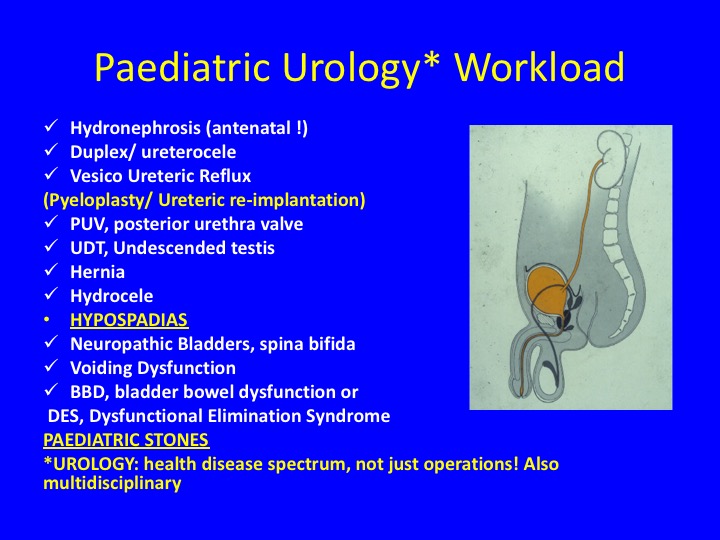
Paediatric Urologyincludes: UDT, undescended testes, inguinal hernia, hydrocele, hypospadias, antenatal hydronephrosis and associated pyeloplasty, ureteric re-implantation, PUV, posterior urethral valve, neuropathic bladder often in association with rampant spina bifida, non-neuropathic voiding dysfunction & BBD, bladder bowel dysfunction.  Urinary stones are still endemic in Sarawak.

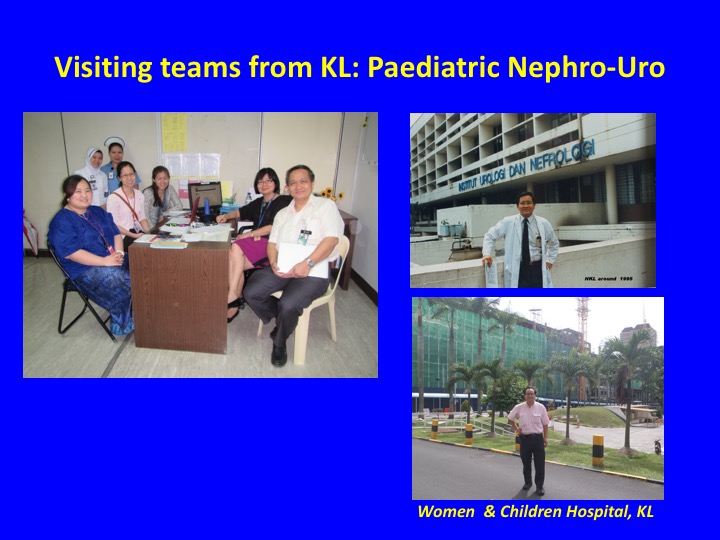
The State of Sarawak was carved out from Brunei by the White Rajahs, beginning in 1841, became a British Colony in 1946 and finally joining Sabah/ Singapore to form Malaysia in 1963. Western medical practices were introduced to Sarawak by the missionaries in the beginning, e.g. the establishment of the Christ Hospital in Kapit from 1957 – 1974.  Paediatric urology would have been part of the general surgical practice.  We have many dedicated giants in general surgery, e.g. PR Sengupta, Sarawak State Surgeon from 1970 – 1987, Ranjit Oommen (I was their houseman in 1981), CJ Cumming Smith from Edinburgh, the late Wong Soon Kai, FRCS Ed. The late Sir James Fraser FRCSEd worked in Sibu from 1958 – 1963. Some general surgeons who qualified as surgeons in 1980s also took an interest in Urology and provided the primary care for paediatric urology patients before sending them to Kuala Lumpur GH.  Since 1990s, the urologists and paediatric surgeons from Kuala Lumpur made visits every few months to the major towns in Sarawak, namely, Kuching, Sibu and Miri to provide a basic service and hoping to entice young surgeons into their discipline! Sarawak also relied on contract surgeons from India, e.g. Dr AMVC Raju and Ganesh Gopalakrishnan who worked in Sarawak in the 1990s.  

The first kidney transplantation of Malaysia was on a young boy from Sarawak who received a kidney from his brother, on 15.12.1975. Since 2000, I have been involved with the paediatric renal transplantation programme in GHKL, with a median of about   x  paediatric kidney transplants done per year.

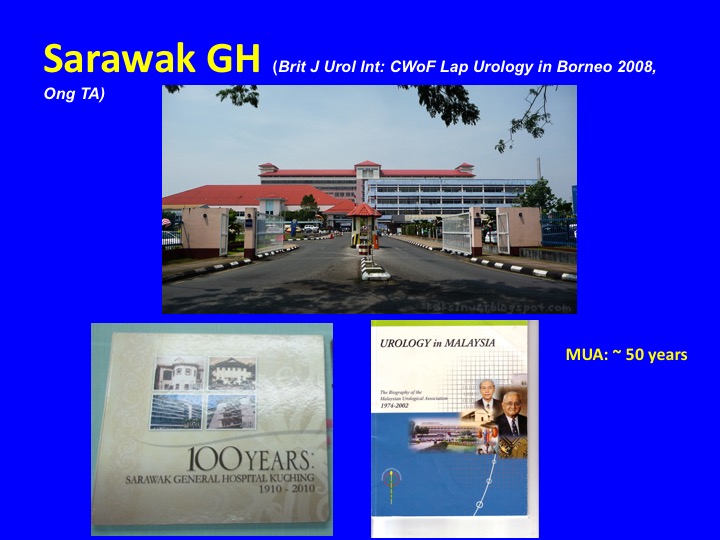
The general hospital of Sarawak,. SGH in Kuching, is the referral hospital of Sarawak. Surgical data are often found in the operation theatre records.  The entire paediatric urology surgical workload of SGH in 2013 were reviewed.  The following are the main cases:  ……The da Vinci robot was introduced to the SGH in 2008, mainly for robotic radical prostatectomy, cystectomy and partial nephrectomy. Nevertheless, the technology is also used for robot assisted laparoscopic pyeloplasty(….).

With better communication and air travel, there are good collaboration efforts with Kuala Lumpur, Sabah and Indonesia. Dr S Rajah established a strong paediatric surgical service in Sabah, cumulating in the establishment of the Likas Women & Children Hospital in Kota Kinabalu. I had the opportunity of taking part in his paediatric surgical campaigns to correct undescended testes and hypospadias, which seems plenty in Sabah. Indonesian patients often cross over from nearby Pontianak to Kuching: I also had opportunity to participate in Indonesian workshops, including on hypospadias with my counterpart Arry Rodjani on 18.10.2013.

CONCLUSION: Sarawak has still has a long way to go in terms of training (a dozen urologists have been trained in Sarawak by the Malaysian Board of Urology, conjoint with FRCSG Urol) and keeping paediatric urologists and the multi-disciplinary team.  There will also be a need for  registries and audit. Needless to say, the team has to work with the necessary hardware in the public hospitals.  

Professor Dr Clarence Lei, FRCS Urol, FEBU, 

BORNEO SURGICAL DELIGHT @ UMS, Sabah, Malaysia, edited 
9thSeptember 2018


Borneo Surgical Delights of Royal College of Surgeons of Edinburgh 9 Sept 2018


Monday, August 6, 2018

Urologic Emergencies in Children, MSN Penang 28 July 2018

Urologic Emergencies in Children

Dr Clarence Lei, FRCS Urol, FEBU
Urologist (Adult, Paediatric and Renal Transplantation)
Adjunct Professor,Universiti Malaysia Sarawak
 Honorary Consultant Urologist, HKL, SGH and Sarawak Heart Centre
 c/o Normah Hospital, Kuching

Introduction, objective and Methodology:

This important topic is illustrated by cases seen at the Urology Departments of Hospital Kuala Lumpur and Sarawak General Hospital, especially since the establishment of the Combined Paediatric-nephrology-urology Clinics at Institute of Urology and Nephrology, Hospital Kuala Lumpur (around 1991) and later at Sarawak General Hospital.

Results:

The urologic emergencies seen in children include the following: 

(a)       Hydronephrosis with renal failure: 

i.           Bladder outlet obstruction: PUV, posterior urethral valve and neuropathic bladder.  PUVs can nowadays be fulgrated with laser via miniature scopes and vesicostomy is seldom necessary, except in remote areas when the baby is very sick. This is the ONLY indication for emergency VCUG.

ii.         Solitary kidney with obstructive hydronephrosis: PUJO, UVJO (other kidney absent or dysplastic).  Unilateral obstructive hydronephrosis is often a dire emergency, fortunately rare.  A caring and patient radiologist can save the child’s life with a percutaneous nephrostomy!  Thereafter, an open direct ureteric re-implantation can be done but with minimal dissection of the trigone of the neonatal bladder.  

iii.       Bilateral hydronephrosis, PUJO/UVJO with renal failure. The renal function is usually adequate to allow the child to grow until it is safer for surgery, usually around 10 kgs when the child can have an open pyeloplasty or even an open tunnelled ureteric re-implantation (Politano Leadbetter type is physiological).

iv.        Hydronephrosis with renal failure from urinary stones. Paediatric stones can be treated just as in adults but with miniature equipment and with minimal use of radiation.

(b)      Acute urinary retention is another urologic emergency and the following are possible causes: 

i.           Phimosis.
ii.         Prolapsed ureterocele in the female.
iii.       Episode of urinary tract infection with underlying chronic retention.

An impacted urethral stone or a prostatic rhabdomyosarcoma is occasionally a cause of urinary retention. The initial urethral catheterisation MUST be done by a doctor with experience in catheterising neonates. Half cc of pure Lignocaine gel can be instilled with a syringe into the urethra.  A small feeding tube (usually 6 Fr) or a smaller umbilical catheter may be inserted. After a few days, the urethra becomes dilated and an 8 Fr silicone Foley’s catheter may then be inserted for a longer term drainage. The neonatal urethra can be easily traumatised by catheterisation and damaged by ischaemic pressure by prolonged catheterisation.  

(c)     Pain of the genital urinary tract is another emergency. The pain can originate from:

i.           Penile pain from balanitis, posthitisor both or para-phimosis or post circumcision complications.  

ii.         Scrotal skin cellulitis.

iii.       Torsion of the testes or the appendix testes: just mention TORSIONand the patient will be seen by the hospital surgical staff urgently!

iv.        Inguino-scrotal swelling including infection, hydrocele, varicocele and hernia.

(c)  Parents are getting more distracted by social media and devices; neglected children may suffer  genital urinary trauma.  Depending on the severity, most patients will get an ultrasound and a low dose contrast enhanced CTU as baseline documentation.  Most such cases can nowadays be treated conservatively (even in kidney fracture) with rest, antibiotics and follow-up with serial ultrasounds.

In April 2017, the US Food and Drug Administration issued a public notification that the use of general anaesthetic and sedations in children younger than 3 years adversely affect brain development.

Conclusions:


Urologic emergencies in children are often present to the family doctor or paediatrician.  Particular care has to be taken when there is acute pain, fever especially with evidence of infection of the genital urinary tract, phimosis, para-phimosis; the acute scrotum is torsion until proven otherwise although only 20% of all scrotal pain is due to torsion.  The child should be referred urgently to a paediatric surgical team with the optimal amenities including nursing care, peri-operative anaesthesia, in addition to specialised surgical operation with magnification and miniaturised tools.  

Urologic emergencies in children, presented at Malaysian Society Nephrology Annual Meetiing 28 July 2018


Followers